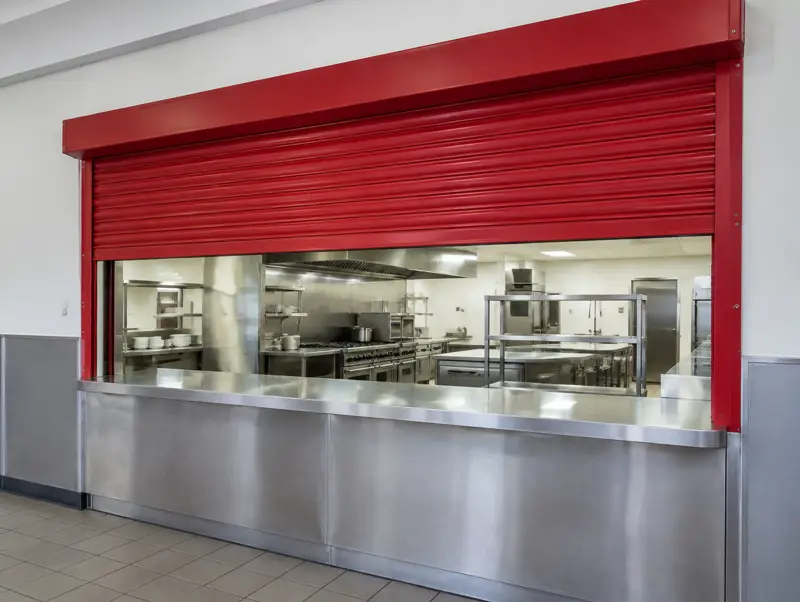
What does a fire shutter do?
A fire shutter closes an opening in a fire-resisting wall, so the wall keeps doing its job. You find them over servery hatches in kitchens, across openings in compartment walls and at the boundary between units.
A security shutter and a fire shutter look alike, but they do different jobs. A security shutter keeps people out. A fire shutter is tested as a complete assembly to hold back fire for a set time. That assembly includes the curtain, the guides, the box and the release, so swapping one part or fixing it into the wrong wall can undermine the test result.
What fire ratings do shutters come in?
Manufacturers commonly sell 60, 120 and 240 minute integrity shutters, and some offer insulated options. Integrity means the shutter resists the passage of flames and hot gases. Insulation limits the heat that reaches the far side, which matters if stock or people could be close to it.
What you need depends on position, and Table C1 of Approved Document B Volume 2 gives the starting point.
| Position | What Table C1 asks for |
|---|---|
| Compartment wall separating buildings | The same as the wall, and at least 60 minutes |
| Access to an external escape route | 30 minutes |
Other positions have their own lines in the table. Your fire risk assessment, fire engineer or building control body should set the figure for your opening. Give us that figure and we will quote to it.
Which test standard should a fire shutter have?
New specifications should favour European classification, with testing under BS EN 1634-1. Table C1 accepts performance under the relevant European standard or BS 476-22 for now, but BS 476 fire resistance references are removed from 2 September 2029.
As we read it, that date affects what you specify for new work and not a shutter already fitted. If you are buying now for a job that could run on, ask for the European classification and keep the paperwork.
Can a fire shutter go across an escape route?
Yes, on conditions. Paragraph C9 of Approved Document B says "Rolling shutters across a means of escape should only be released by a heat sensor, such as a fusible link or electric heat detector, in the immediate vicinity of the door."
The reason is simple. A shutter that drops when an alarm goes off anywhere in the building could close across people still leaving. A local heat sensor closes it only when the fire is close. Unless the shutter also forms a smoke reservoir boundary, "shutters across a means of escape should not be closed by smoke detectors or a fire alarm system".
The shutter must also be capable of manual operation for firefighting. Check how this works on any quotation, as it is a question to settle before ordering.
Can a security shutter go over a fire exit?
Not without a clear answer from your fire risk assessment. Article 14 of the Fire Safety Order says "sliding or revolving doors must not be used for exits specifically intended as emergency exits", and that emergency doors must not be fastened so they cannot be "easily and immediately opened".
The article does not name roller shutters, so how it applies to one is not settled. If a shutter closes over a designated exit, ask the person who wrote your fire risk assessment before we fit anything. We raise this at survey, because it can change the design of the whole frontage.
How often should a fire shutter be serviced?
We found no legal interval for fire shutters, so follow the manufacturer's instructions and your fire risk assessment. The duty itself is clear. Article 17 of the Regulatory Reform (Fire Safety) Order 2005 says premises and equipment must be "subject to a suitable system of maintenance" and kept "in an efficient state, in efficient working order and in good repair".
That duty sits with the responsible person, usually the employer or whoever controls the premises. BS 8214:2026 covers fire door assemblies, and its published summary does not mention shutters. DHF's TS 013-4:2025 covers fire shutters but is available only to course delegates. So ask the manufacturer, and record each test and drop.
Our standard service and safety check costs £174 per shutter inc VAT (£145 plus VAT) and leaves a written condition report. Tell us when you book if the shutter is fire-rated, so we can agree what the visit covers and confirm any extra cost first.
How much does a fire shutter cost?
A fire-rated shutter starts from £3,840 inc VAT (£3,200 plus VAT). The final price depends on the opening, the rating and how the shutter releases.
| Opening | Inc VAT | Plus VAT |
|---|---|---|
| 2.4 x 2.4 m | £3,840 to £4,314 | £3,200 to £3,595 |
| 3.0 x 2.6 m | £4,074 to £5,274 | £3,395 to £4,395 |
| 6.0 x 3.0 m | £7,554 to £9,594 | £6,295 to £7,995 |
Lead time is 4 to 6 weeks after survey. The survey and quotation for a new fire shutter are free. Get a guide price, and have your fire risk assessment or specification to hand.
What information do you need to quote?
We need the rating, the size and the wall type. It also helps to know whether the opening sits on an escape route, what closes it, and who holds the fire risk assessment. Older buildings can raise questions about the wall itself, because the shutter can only perform as well as what it is fixed to. A kitchen servery is often the simplest case, while a shutter tied into an alarm system takes more planning.
Common questions
What is the difference between a fire shutter and a fire door?
Both protect an opening, but a fire shutter rolls down from a box and stays open in normal use. A fire door is usually kept closed or held open on a release. The tests and maintenance needs differ, so follow the manufacturer's instructions.
Do I need a fire shutter on a kitchen servery?
It depends on the wall around the servery and your fire risk assessment. If the hatch is an opening in a fire-resisting wall, it usually needs protecting. Ask the person who wrote your assessment.
Can a fusible link be used on a fire shutter?
Yes, on an escape route Approved Document B names a fusible link or electric heat detector close to the door as acceptable release methods.
Who is the responsible person?
Usually the employer, or whoever has control of the premises. In a multi-let building, more than one person can hold duties. Check your lease and your fire risk assessment.
How long does a fire shutter take?
Fire-rated shutters take 4 to 6 weeks after survey. If the job needs building control or planning, allow for that first.
Sources
Related services
Fire-rated shutters
Tested assemblies for servery hatches and compartment openings.
from £3,840 inc VAT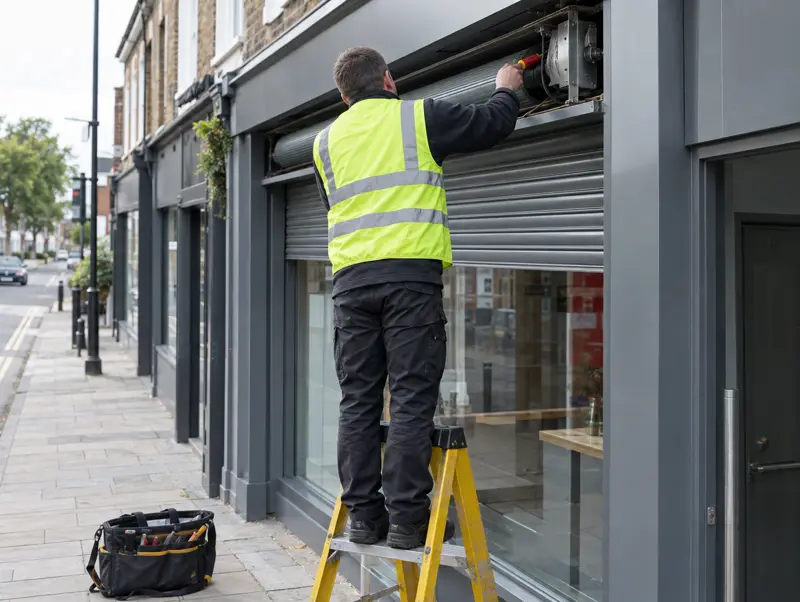
Roller shutter servicing
A planned service and safety check with a written report.
from £174 per shutter inc VAT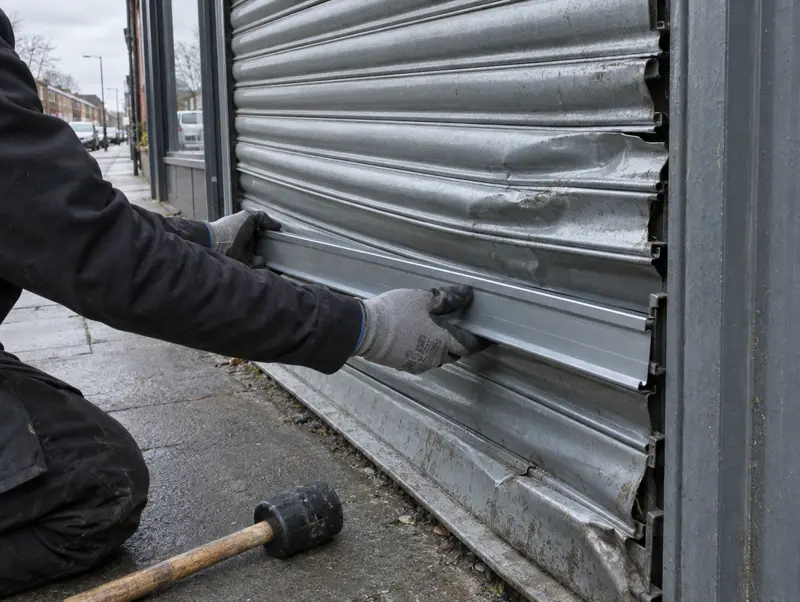
Shutter repairs and servicing
A call-out to find the fault. Repairs and parts are quoted before we start.
call-out from £174 inc VAT