What does an LPS 1175 rating mean?
It tells you which tools a product resisted and for how long. LPS 1175 is the intruder resistance standard published by the Loss Prevention Certification Board, known as LPCB. Its scope includes shutters, grilles and blinds.
A rating such as B3 has a letter and a number. The letter is the threat level, which sets the toolkit used in the test. It runs from A to H, and the tools get more serious as the letters rise. The number is the delay, in minutes: 1, 3, 5, 10, 15 or 20.
So A1 means toolkit A for 1 minute, and D10 means toolkit D for 10 minutes. A higher rating resists stronger tools for longer. Delay matters, because it is the time you are buying for an alarm or passer-by to raise help.
What is LPS 1175 Issue 8.2?
Issue 8.2 is the current version of the standard, amended in September 2024. It is also the latest revision that Secured by Design accepts, according to an archived copy of its standards page from April 2026.
When you read a certificate, check which issue it refers to. Older issues used a different rating format, and that is where much of the confusion on the market comes from.
What does a rating not cover?
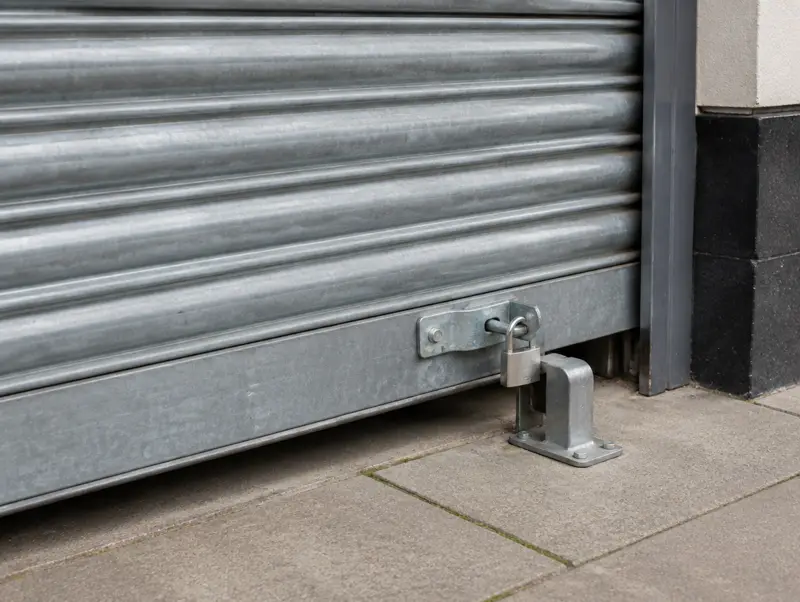
A rating covers the product when it is locked, and only then. Issue 8.2 says the rating applies in the locked condition. It treats padlocks as part of the product, and it assumes the wall or frame around the product is at least as strong.
That has real consequences on a shop frontage:
- A shutter left unlocked, or on a different padlock from the one tested, may not match its rating.
- A strong shutter fixed into soft brick or a thin frame is only as strong as those fixings.
- The rating says nothing about the glass behind or beside the shutter.
This is why the fixing plan matters as much as the product. A rating depends on correct locking and fixing.
Is SR2 the same as B3?
By trade convention, yes, but LPS 1175 Issue 8.2 contains no official mapping. SR numbers come from older usage. Suppliers still pair them with letter ratings, and some certificates show both side by side, so the first 4 pairings are widely used. Treat those as a convention, and never as a rule.
Above SR4 the picture is less clear. Sources list different pairings, and some decline to pair them at all, so we do not give any.
| Letter rating | Common trade label | How firm is this? |
|---|---|---|
| A1 | SR1 | Convention, seen on some certificates |
| B3 | SR2 | Convention, seen on some certificates |
| C5 | SR3 | Convention only |
| D10 | SR4 | Convention only |
| E and above | SR5 to SR8 | No agreed pairing, check the certificate |
If a policy or specification says SR2, ask what it means in Issue 8.2 terms, then get the answer in writing.
How do I ask for a certificate?
Ask for the certificate before you order, and check it against the product you are buying. Work through these steps:
- Ask for the certificate number and a copy of the certificate.
- Check the holder, the product name and the model match the quotation.
- Check the rating, written as a letter and a number, and the issue of LPS 1175.
- Look the product up on the Red Book, the public LPCB listing, to confirm it is current.
- Ask whether your opening size and locking method fall within what was certified.
- Ask how the shutter will be fixed to your wall or frame.
- Keep the certificate with your insurance papers.
Be cautious of "tested to" or "designed to meet". A certificate from a certification body is a stronger thing than a supplier's statement.
How does LPS 1175 relate to Secured by Design?
They are linked but separate. Secured by Design accepts LPS 1175 and also STS 202 Issue 10:2021, a different standard with ratings from BR1 to BR6, whose scope includes roller shutters. PAS 24:2022+A1:2024 is for doorsets and windows, so it does not apply to a shutter.
A product can hold one rating and not the other. If someone asks for STS 202, an LPS 1175 certificate may not answer the question, so ask them which they will accept. Secured by Design's commercial guide names both.
Which LPS 1175 rating does my shop need?
There is no legal minimum for a shop. The question usually comes from your insurer, a landlord or a specification, so ask them for the exact wording. We found no UK insurer publishing a minimum for shops, as our guide to insurance and shutters explains.
Without a requirement, think about the risk. Stock value, trading hours, the rear of the unit and how quickly someone would respond all matter. A certified shutter on the front is less use if the back door is the weak point.
Can you supply a certified shutter?
Yes: if your insurer asks for a rating, tell us before ordering and we will price a product certified to it and give you the certificate. Our guide prices do not assume a rated product, so a certified shutter is priced at quotation. The survey for a new shutter is free. Start with a guide price or see the electric shutter page.
Common questions
What is the difference between LPS 1175 and LPCB?
LPS 1175 is the standard. LPCB is the board that publishes it and certifies products against it.
Does LPS 1175 cover the whole shopfront?
No. A rating applies to the certified product. The glass, frame and wall around it are separate, which is why the fixing plan matters.
Is a higher rating always better?
Not always. A higher rating usually means a heavier product and a higher price, and it depends on the wall it fixes to. Match the rating to what your insurer or specification asks for.
Can an existing shutter be given a rating?
Assume not, unless it was made as a certified product and you can identify it. A rating belongs to the certified product. Ask the original supplier for the certificate number.
Is LPS 1175 a legal requirement?
No law requires it for a shop. It may be required by your insurer, landlord or a project specification.